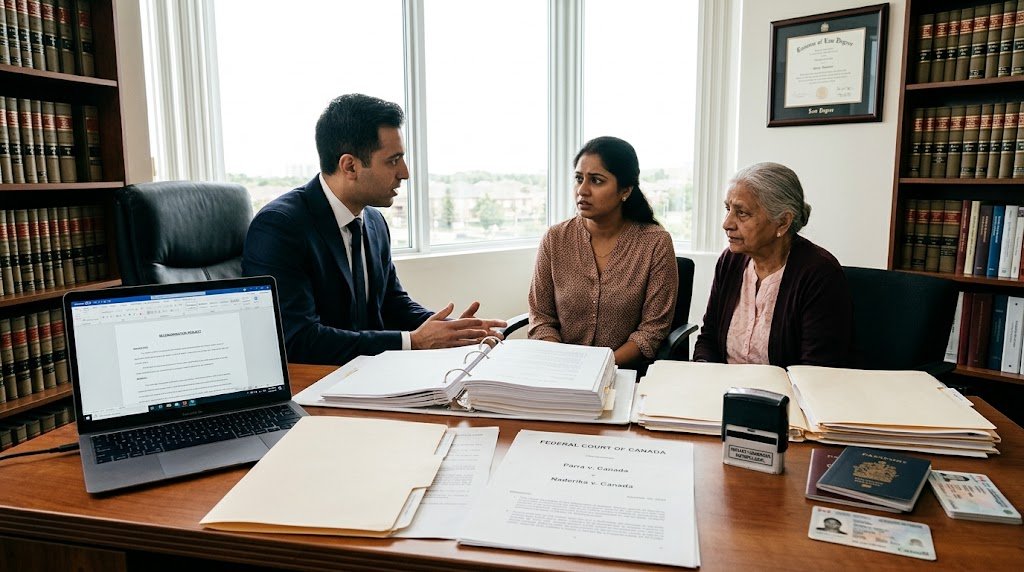
For Canadian citizens and permanent residents in Mississauga, Brampton, and the Greater Toronto Area (GTA), immigration applications, especially the Parents and Grandparents Program (PGP)-represent a highly coveted opportunity for family reunification. When an application is refused due to a minor administrative error or a technological glitch, it is utterly devastating. For years, Immigration, Refugees and Citizenship Canada (IRCC) has taken a notoriously rigid stance on incomplete applications, often penalizing sponsors for simple oversights.
However, a pair of Federal Court decisions, spanning over a decade apart, provides a powerful precedent for fairness and common sense. In the recent decision of Parra v. Canada (Citizenship and Immigration), 2026 FC 1300, the Federal Court set aside an IRCC officer’s refusal to reconsider an application that was rejected simply because documents were sent to the wrong email address. This decision heavily echoes the foundational legal principles established in Naderika v. Canada (Citizenship and Immigration), 2015 FC 788, where a Federal Skilled Worker refusal was overturned after an officer refused to look at evidence submitted the exact same day as the refusal.
At Ghuge Legal, we analyze the importance of the Federal Courts decision on the processing of the immigration applications. In this comprehensive guide, we will analyze the facts of the Parra decision, compare it to the precedent set in Naderika, and explain the underlying legal principle that allows GTA families to protect their applications from unreasonable bureaucratic rigidity.
Anatomy of an Innocent Mistake: The Facts of Parra v. Canada (2026)
The Parra case serves as a modern cautionary tale about the perils of technological communication and the rigid nature of IRCC processing.
The applicant, Elvia Raquel Parra, applied to sponsor her parents for permanent residence under the 2024 PGP application cycle. During the processing of the file, an IRCC officer identified missing forms and, on November 29, 2024, requested that they be submitted within 30 days.
Acting promptly, the representative attempted to respond to IRCC’s request. On December 4, 2024, the Applicant’s representative sent the form to IRCC, but sent it to a different, incorrect IRCC email address than the one the information should have been forwarded to. Because the emails were misaddressed, IRCC concluded the applicant had ignored the request and officially rejected the PGP application as incomplete.
On January 13, 2025, the Applicant again received correspondence from IRCC indicating that the Application did not meet the processing requirements and for the missing forms to be submitted within 30 days. The Applicant’s representative responded to this on January 22, 2025, sending the required forms to a different incorrect IRCC email address. On February 28, 2025, the Application was rejected as incomplete.
On March 3, 2025, immediately realizing the error, the applicant submitted a formal request for reconsideration to IRCC, attaching the missing documents and showing proof of the original, misdirected email. On March 11, 2025, IRCC responded to the reconsideration request. Astonishingly, the immigration officer acknowledged that the applicant had made a genuine attempt to respond on time. Despite this acknowledgment, IRCC refused to reopen the file, maintaining that it was not their responsibility that the documents failed to reach the correct office.
Faced with a finalized refusal, the applicant filed an Application for Leave and for Judicial Review at the Federal Court of Canada.
The Historical Precedent: Naderika v. Canada (2015)
To understand why IRCC was wrong to refuse Ms. Parra’s request, we must look at a remarkably similar case from 2015: Naderika v. Canada (Citizenship and Immigration), 2015 FC 788.
In Naderika, an Iranian citizen applied for permanent residence under the Federal Skilled Worker class. His application’s success hinged on five adaptability points, which he claimed for having a qualifying relative living in Canada. Immigration authorities asked for updated proof that this relative was still residing in Canada. When the proof was allegedly not received in time, the officer refused the application.
However, on the exact same day that the refusal was issued, the applicant’s consultant contacted the visa office to state that the documents had indeed already been submitted. The consultant then re-sent the documents the very next day. Despite this immediate correction, the officer refused to reconsider the file.
The Federal Court intervened and overturned the refusal, ruling that reconsideration may be appropriate where missing or disputed evidence is provided immediately after a refusal and clearly addresses the exact issue that caused the application to fail.
The Underlying Legal Principle: Functus Officio vs. Procedural Fairness
When comparing Parra (2026) and Naderika (2015), a clear, unifying legal principle emerges regarding how Canadian administrative law balances finality with fairness.
In administrative law, once a final decision is made, the decision-maker is generally considered functus officio (their jurisdiction has ended). An officer cannot simply reopen a file months later because an applicant requested for a reconsideration. However, the Federal Court in both Naderika and Parra affirmed that immigration officers retain a limited discretionary power and in some cases, a legal duty to reconsider a decision when exceptional circumstances arise.
The Shared Principle: The courts in both cases established that an officer acts unreasonably if they rigidly hide behind the functus officio doctrine when an applicant provides highly material, curative evidence immediately following a refusal.
In both cases:
- The original refusal was based on a perceived failure to provide a document.
- The applicant made a good faith attempt to comply.
- The applicant or their representative submitted the missing evidence almost instantly upon realizing the application was refused (the same day in Naderika, and within days in Parra).
The Federal Court’s stance is clear: when missing evidence is provided immediately after a refusal and directly cures the defect that caused the failure, an officer must genuinely engage with that reality rather than issuing a blanket denial.
The Federal Court Ruling in Parra: Enforcing the Principle
When Justice Thorne reviewed the Parra case in late 2026, he applied the exact logic that governed Naderika.
Under the framework established by the Supreme Court in Vavilov, a reasonable administrative decision must display justification, intelligibility, and transparency. Justice Thorne noted a glaring contradiction in the IRCC officer’s decision: the officer explicitly acknowledged that the applicant had made a genuine, timely effort to submit the missing documents, yet failed to adequately explain why reconsideration was not warranted in light of that specific evidence.
By simply pointing to the ultimate failure of delivery while ignoring the good-faith attempt to comply, the officer’s reasons lacked sufficient justification and transparency. Consequently, the Federal Court granted judicial review, set aside the reconsideration decision, and remitted the matter back to a different officer for redetermination.
(Note: The Court did not direct IRCC to approve the sponsorship application outright, nor was a question of general importance certified. It simply forced IRCC to properly and fairly reassess the reconsideration request and remitted the file back to a different officer.)
Strategic Lessons for GTA Sponsors and Applicants
If you are a resident of Mississauga, Brampton, or the GTA navigating complex IRCC procedures, the Parra and Naderika decisions offer several critical strategic takeaways:
1. Act Immediately Upon Refusal
The reason the applicants succeeded in both Parra and Naderika was the speed of their response. In Naderika, the consultant reached out the very same day. In Parra, the reconsideration request was submitted within days. This immediate action proved to the Court that the applicants were diligent. If you receive a refusal, do not wait. Contact a litigation lawyer immediately.
2. Document Every Attempt at Compliance
The applicant in Parra won because they could prove they attempted to send the email on December 4. Keep meticulous records of every web form submitted, every email sent, and every courier tracking number. If an error occurs, this paper trail is your only defense in Federal Court.
3. Do Not Take “No” for an Answer on Clerical Errors
IRCC officers process thousands of applications and often rely on rigid templates. When an officer refuses to reconsider a file due to a minor, immediately corrected administrative glitch, they are taking the easy way out. The Federal Court has proven over the last decade that this rigidity is not legally acceptable when it defies basic fairness.
4. Respect the Judicial Review Deadlines
A reconsideration request is a discretionary plea; it is not a legal right. Furthermore, submitting a reconsideration request does not pause the strict statutory deadlines for filing a judicial review. You generally have 15 days to file for Judicial Review if the decision was made inside Canada, and 60 days if the decision was made outside Canada.
Why Choose Ghuge Legal
At Ghuge Legal, we meticulously review refused applications to identify procedural fairness breaches, unreasonable officer conclusions, and factual errors that warrant a Federal Court appeal. If your application has been unreasonably refused due to a clerical mistake, missing email, or administrative glitch, the law provides mechanisms to fight back.
👉 Book your consultation with Ghuge Legal today
Note: The above article is for information purpose only and not a legal advice